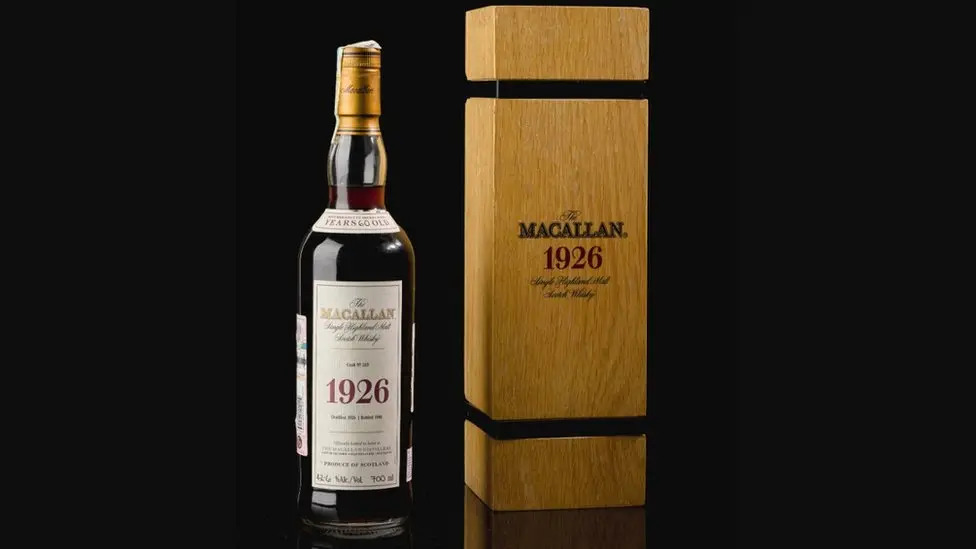
A bottle of The Macallan 1926 has sold for £2.125 million at a Sotheby’s auction held at The Macallan Estate in Speyside, once again placing one of Scotch whisky’s most celebrated releases at the very top of the global collector market.
Distilled in 1926 and matured for 60 years, the Fine & Rare bottling came from the now-legendary cask number 263, from which only 40 bottle equivalents were produced.
The result is extraordinary, but the more interesting question for collectors and investors is this:
Why can one bottle of whisky command more than £2 million?
A whisky a century in the making
The Macallan 1926 was distilled a full century ago and spent six decades maturing before being bottled in 1986.
Only 40 bottle equivalents were drawn from the cask, making the release exceptionally limited from the outset. Of those, a small number were presented with The Macallan’s Fine & Rare label, while other bottles became associated with artists including Sir Peter Blake and Valerio Adami.
Over time, those bottles have become some of the most sought-after whiskies in the collector market.
The latest sale does not quite surpass the record achieved in 2023, when another bottle from the same cask sold for £2,187,500, but it reinforces the exceptional status of The Macallan 1926 and the strength of demand at the very top end of the rare whisky market.
What makes one bottle worth £2.1 million?
Age is part of the story, but age alone does not explain a valuation of this scale.
The Macallan 1926 combines several factors that collectors place significant value on: exceptional scarcity, strong provenance, historic significance, distillery reputation and sustained global demand.
The Macallan itself is one of the most recognised names in single malt Scotch whisky, while this particular release has developed an almost legendary position within the auction market.
Condition and provenance are equally important.
At this level, buyers want confidence around authenticity, ownership history, storage and the physical condition of the bottle. That assurance can make the difference between an interesting old bottle and a highly desirable collector asset.
Why scarcity matters
One of the defining characteristics of collectable whisky is that genuinely finite releases cannot be recreated.
Once a whisky has been distilled and bottled, no more of that exact vintage or release can be produced. Over time, bottles may be consumed, damaged or disappear permanently into private collections.
As availability reduces, scarcity can become increasingly significant — particularly when demand remains strong.
The Macallan 1926 is an extreme example of this principle. Very few bottles were produced in the first place, and even fewer remain available to the open market today.
That combination of finite supply and global collector interest is one of the reasons bottles from cask 263 continue to command such extraordinary prices.
Rare bottles and whisky casks are not the same market
For investors, it is important to put headline auction results like this into context.
The rare bottle market and the cask whisky market should not be viewed as interchangeable.
Rare bottles are influenced heavily by collectability, condition, release history, provenance and auction demand. Whisky casks introduce additional factors including maturation, alcohol strength, cask type, storage, ownership documentation and eventual exit options.
So while a £2.1 million bottle makes for an extraordinary headline, it should not be interpreted as evidence that whisky casks generally will experience comparable levels of appreciation.
What the sale does demonstrate is the importance of understanding the characteristics that create desirability within the wider whisky market.
What can whisky investors learn from the sale?
For cask investors, many of the underlying principles remain relevant.
Distillery reputation matters. Provenance matters. Scarcity matters. Quality matters. Market demand matters.
But no single factor should be considered in isolation.
Simply owning an older cask does not automatically make it more valuable. A cask’s quality, alcohol strength, storage history, documentation, distillery, marketability and likely future buyer demand all contribute to the wider picture.
This is where careful sourcing and due diligence become particularly important.
The Fine Worth perspective
The Macallan 1926 is an exceptional piece of whisky history, and auction results of this magnitude are rare.
But that is precisely what makes the sale useful as a market case study.
The most desirable collectable assets often share several characteristics: genuine scarcity, verifiable provenance, strong reputation and sustained demand.
At Fine Worth, we believe informed ownership begins with understanding the asset itself — its provenance, quality, storage, characteristics and the market surrounding it.
The latest Macallan sale may belong to the world of ultra-rare bottles, but the wider lesson applies across whisky collecting and cask investment:
Know what you own, understand why it is scarce, and never overlook the importance of provenance.
Interested in understanding the cask whisky market? Explore Fine Worth’s latest insights or speak with our team to learn more about our approach to sourcing, provenance, storage and portfolio guidance.
Past auction results and historical market performance are not indicative of future returns. Whisky and fine wine values can rise or fall, and investment outcomes are not guaranteed.